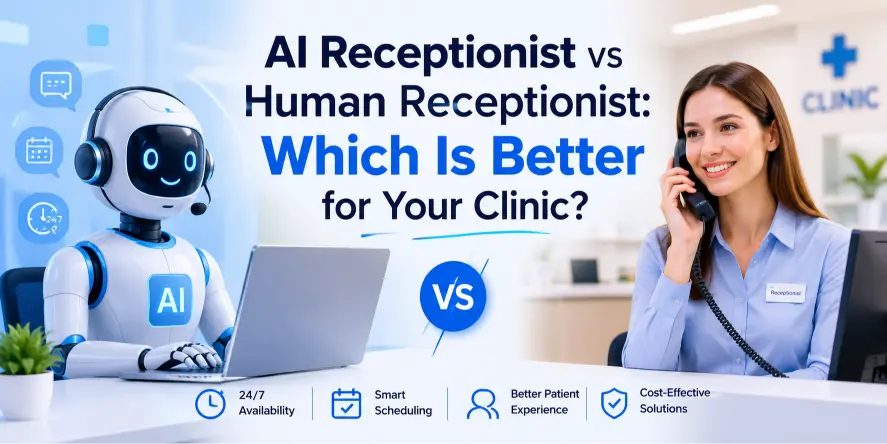
Front-desk staffing is one of the most quietly expensive problems in healthcare. Missed calls, no-shows, overwhelmed staff during flu season, and after-hours voicemail black holes all chip away at patient trust and clinic revenue. As more practices look for a fix, the conversation keeps landing on the same question: AI vs human receptionist — and which one actually serves patients better.
This isn’t a simple “robots vs people” debate. It’s a practical staffing and patient-experience decision, and the right answer depends on call volume, budget, and the type of care a clinic provides. Below, we break down how a Medical office AI receptionist stacks up against a traditional front-desk hire, where each one wins, and how many clinics are landing on a hybrid model instead of picking a single side.
The Core of the AI vs Human Receptionist Debate
At its simplest, the AI vs human receptionist question comes down to availability versus judgment. A human front-desk employee brings empathy, nuance, and the ability to read a distressed patient’s tone in a way software still can’t fully replicate. But that same employee also needs breaks, sick days, and can only handle one caller at a time — which means every busy Monday morning turns into a queue of hold music and abandoned calls. A Medical office AI receptionist flips that equation. It answers every call instantly, at any hour, without needing coffee breaks or vacation coverage. For clinics that lose patients to voicemail during lunch rushes or after 5 p.m., this alone can be the deciding factor in the AI vs human receptionist comparison.
Where Human Receptionists Still Win
Front-desk staff remain essential in situations that require emotional intelligence. A patient calling about a frightening diagnosis, an anxious parent asking about a sick child, or a complex insurance dispute all benefit from a real person who can adapt on the fly, escalate appropriately, and offer genuine reassurance. This is the strongest argument on the “human” side of the AI vs human receptionist discussion — some conversations simply need a person. Human staff are also better positioned to manage in-office tasks that go beyond the phone: greeting patients as they walk in, handling co-pay collection face-to-face, and managing the physical flow of a busy waiting room. A Medical office AI receptionist can’t check someone in at the counter or comfort a nervous patient in the lobby.
Where a Medical Office AI Receptionist Wins
Cost and consistency are where the AI vs human receptionist scale tips heavily toward automation. A full-time receptionist, once you factor in salary, benefits, training, and turnover, is a significant fixed cost — and most clinics still need backup coverage for sick days and lunch breaks. A Medical office AI receptionist doesn’t call in sick, doesn’t need PTO, and scales instantly during flu season or a marketing push that suddenly doubles call volume. Speed and accuracy also favor the AI Receptionist model for repetitive front-desk tasks. Booking, rescheduling, and cancelling appointments, answering questions about hours, insurance acceptance, and location, and sending appointment reminders are all high-volume, low-nuance tasks. A well-built Medical office AI receptionist handles these instantly and without error, freeing up human staff to focus on the calls that actually need a human touch. After-hours coverage is arguably the single biggest win in the AI vs human receptionist comparison. Most clinics close their phone lines overnight and on weekends, which means every after-hours call either goes to voicemail or gets lost entirely. A Medical office AI receptionist can answer at 2 a.m. just as reliably as at 2 p.m., capturing bookings and urgent triage requests that would otherwise become no-shows or, worse, patients who simply call a competitor instead. There’s also a data advantage. Every call handled by a Medical office AI receptionist can be logged, transcribed, and analyzed — giving clinic owners visibility into call volume patterns, common patient questions, and missed-opportunity trends that are nearly impossible to track consistently with a human-only front desk.
The Real-World Verdict: It’s Rarely All-or-Nothing
Most clinics that have actually tested both sides of this decision don’t end up picking one exclusively — they combine them. A common and effective structure looks like this:
- Daytime, in-person tasks: handled by human staff, who greet patients, manage the waiting room, and handle sensitive conversations
- Phone overflow and after-hours calls: handled by the automated system, so no call goes unanswered regardless of time or volume
- Routine scheduling and reminders: automated through the AI Receptionist, reducing no-show rates and freeing human staff from repetitive admin work
- Complex or emotionally sensitive calls: automatically routed or escalated to a human team member
- This hybrid approach tends to outperform either option on its own. Clinics get the warmth and judgment of a real person exactly where it matters most, without losing revenue to missed calls during the hours a human team simply can’t cover.
Questions to Ask Before Choosing
If a clinic is weighing this decision seriously, a few questions tend to clarify the right path: 1. How many calls go unanswered or to voicemail each week? If it’s a meaningful number, an automated front desk will likely pay for itself quickly in recovered bookings. 2. What percentage of calls are routine versus emotionally complex? Clinics with a high ratio of scheduling and general-inquiry calls see the fastest ROI from automation. 3. What does after-hours coverage currently look like? If it’s voicemail only, this is often the single easiest upgrade a practice can make. 4. How much does turnover cost the front desk? Training new receptionists repeatedly is expensive, and an automated system doesn’t need to be re-trained every time someone leaves.
What Patients Actually Notice
Interestingly, most patients don’t care what’s on the back end — they care whether their call gets answered, their appointment gets booked correctly, and their question gets a clear answer. Surveys on patient experience consistently show that speed and responsiveness rank above almost everything else when it comes to first impressions of a clinic. A caller who reaches a fast, accurate booking system at 9 p.m. often walks away happier than one who sat on hold for ten minutes during business hours, even if the first interaction was with software and the second was with a person. This is worth remembering when clinics get stuck debating the philosophy of automation versus staffing. The patient isn’t grading effort — they’re grading outcome. If the call gets answered promptly and the problem gets solved, satisfaction tends to follow, regardless of which side of the front desk handled it.
Final Thoughts
The AI vs human receptionist conversation isn’t really about replacing people — it’s about matching the right tool to the right task. A Medical office AI receptionist excels at speed, availability, and consistency, handling the repetitive, high-volume work that used to eat up a front desk’s entire day. Human receptionists remain irreplaceable for empathy, judgment, and in-person patient care. The clinics seeing the best results aren’t choosing sides in the AI vs human receptionist debate — they’re building a front desk that uses both, and letting each one do what it does best. For clinics ready to stop losing patients to missed calls and long hold times, Reply Amp builds exactly this kind of solution — an AI Receptionist designed specifically for medical practices that never sleeps, never misses a call, and works alongside your existing team instead of replacing it.